
Chord Confessions 1
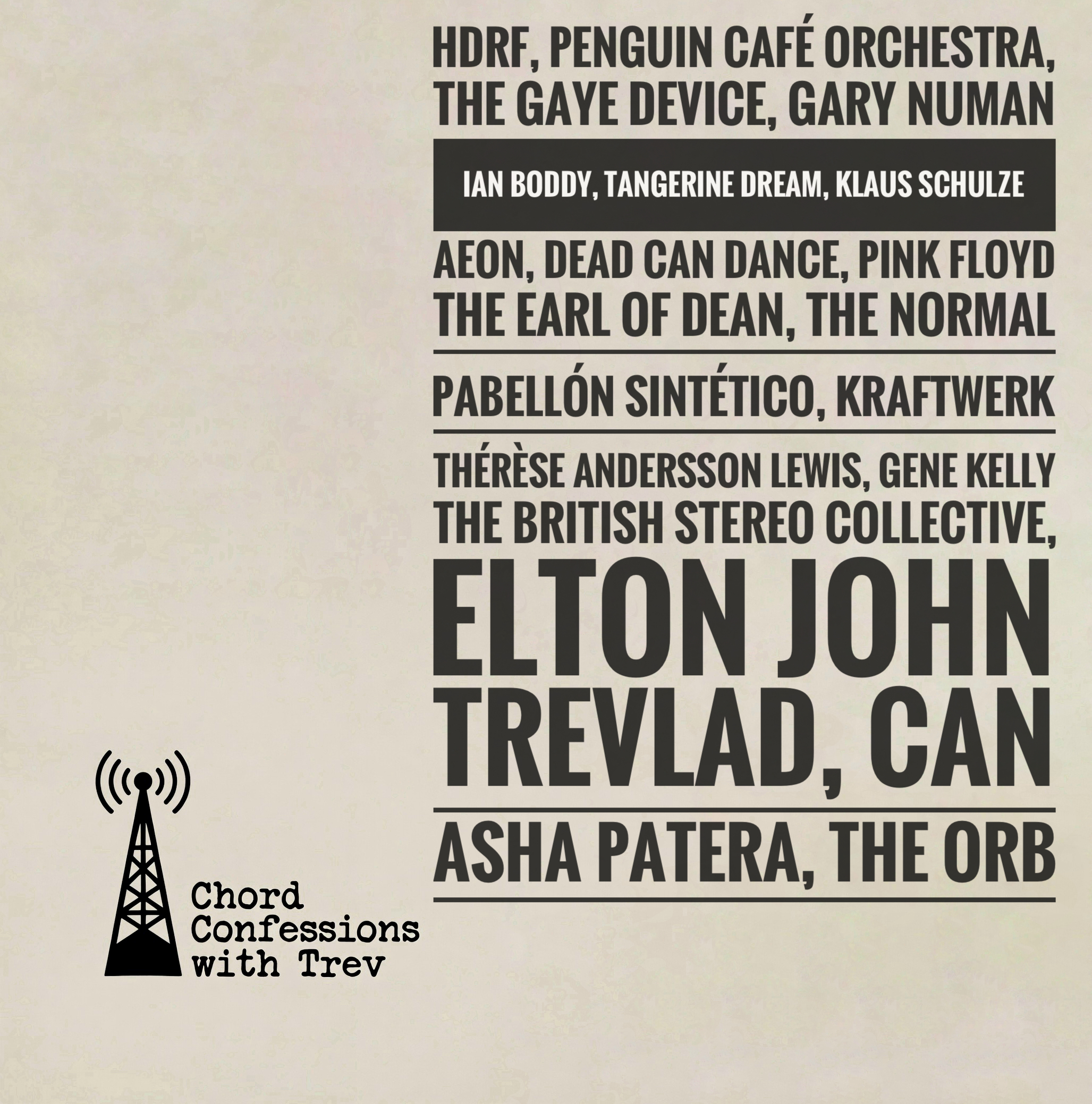
Well at last here it is the pilot episode of Chord Confessions.
The idea is simple. What is a piece of music that has had a profound impact on you? And what’s the story behind it. That’s it.
I get to say nice things about you. You get to tell your life changing story, and we all get tot hear the most important music on the planet.
I was thinking of starting off the show with a an entry of my own but changed my mind when this fine chap sent his story. Anyone who has crossed his path will instantly have a smile on their face when I mention Gareth Evans. Such a wonderful supporter of the electronic community, a fantastic sense of humour and a humble soul.
Gareth Evans, better known by his aliases HDRF and Horror Dwarf, is a UK-based electronic musician and synth enthusiast hailing from the market town of Omskirk in West Lancashire UK . He crafts atmospheric, experimental soundscapes that blend retro-futurism, prog influences, and dare I say a love for classic horror aesthetics.
Evans adopted the “Horrordwarf” moniker back in 2001 for his SoundCloud uploads, later streamlining it to HDRF as his primary project name. Since diving into production with a used Mac and audio interface, he’s built a prolific catalog on Bandcamp, with over a dozen releases across various labels, including live improvisations, long-form ambient pieces like Pseudochrome 92, and themed works such as Live Soundtracks to Silent Films (featuring Roland synths for eerie, cinematic vibes).
A self-described “middle-aged synth enthusiast,” he performs live sparingly but memorably—recent highlights include sets at events like Switched On in Whitby—and collaborates with figures in the underground electronic scene. Whether invoking dusty memories, exploring wire-and-water drones, or channeling spectral voyages, HDRF’s music carries a distinctive, retro-infested-synth charm that’s equal parts nostalgic and forward looking.
Check out his Bandcamp at hdrf.bandcamp.com for the full haunting discography.
Here’s Gareth’s story:
My gateway drug into musical maturity and the world of leftfield ambient music.
I stumbled across the Penguin Cafe Orchestra in a late night BBC concert broadcast in 1989 (and never repeated).
Arriving home at the end of our annual book shopping/fish and chips trip to Southport with my mum. We ate at our favourite restaurant, Chip Ahoy (I’m not joking here) and trawled the multitude of second hand bookshops that were there in the day (almost all gone now).
I remember I picked up a book called The Devil Hunter, about Father Amarth (later the subject of a documentary film by William Friedkin and a rather dire film starring Russell Crowe, entitled The Pope’s Exorcist) and read it on the bus home.
I probably picked up some Pan Horror stories or something classy by Guy N Smith too.
It was the school summer holidays so no requirement to get up early so I did my usual thing of scouring all 4 channels available to me on my portable TV.
I’ve wanted to re-watch it for years and I’ve just (to my delight) found it on YouTube. I figure this is the 1988 lineup from the When in Rome album (with Annie Whitehead on Trombone)
Penguin Cafe Orchestra – Live at the BBC 1989
The late 80’s were a weird time for music. Dance music hadn’t evolved into a state that I found acceptable (although Acid house was creeping into my consciousness). I wasn’t big on the rock bands of the time (other than The Cure and Talk Talk). This was something else. Organic, intimate and unlike anything I had ever heard before. I loved the whole concert, but it was the final track that blew me away. Seeing them probably took my music journey into a far more leftfield and better direction. I’d say that watching this concert was a pivotal moment. My “Sex Pistols at Lesser Free Trade Hall” only without the swearing.
As I worked my way through their brief and beautiful back catalogue, the standard album overall is 1987’s Signs of Life. I love every track on that album and probably listen to it (along with Spirit of Eden) at least once a month.
Broadcasting from Home (from which Harmonium forms the opening) is a mixed bag. Ryuichi Sakamoto shows up on one track (He returns the favour later in the decade by allowing Simon Jeffes to guest on Field Music, on his Illustrated Musical Encyclopedia album, which also features Thomas Dolby).
The story of the track is equally odd. During a visit to Japan, Simon Jeffes finds the Harmonium dumped, brings it back to his hotel and composes the tune on it.
The track has been covered by a wide range of artists (there are a lot of Irish bands doing it). Even The Orb did a version entitled Pandaharmonium. Alex Paterson’s day job was A&R for Brian Eno’s EG label which probably explains the connection.
I was heartbroken when Simon passed away in 1998 aged just 49.
I never got to see them in concert, but thankfully the Penguin Cafe lives on, with a bunch of young musicians led by Simon’s son Arthur who is astonishingly talented.
I was very fortunate to meet him last year during a solo piano recital in Liverpool and finally got the chance to tell him how much his father’s music meant, and continues to mean, to me.
Thanks for that Gareth and here it is Penguin Cafe Orchestra. with Music for a Found Harmonium.
Amazing stuff there from Penguin Café Orchestra and Music for a Found Harmonium sent in by HDRF.
We stay in the Uk now and head to scenic West Yorkshire more specifically Morley. A kosmische-inspired electronic ambient project who is Andrew Howden better known as The Gaye Device. Andrew Crafts reflective, immersive soundscapes that evoke cosmotronic daydreams and cloud-watching serenity, the Gaye Device draws from vintage synth textures, subtle kosmische influences, and introspective atmospheres—often with a gentle, meditative drift that feels both nostalgic and expansive.
Active for over two decades, The Gaye Device has built a steady discography of full-length albums and contributions to compilations, released on respected underground labels including Submarine Broadcasting Company, Sounds For The Soul Records, Machina Ad Noctem, and others. Standout releases include Ruins exploring haunted abbey themes), Structures, The Cut Sleeve (2023), and more recent works like Electrohome (March 2025), The Nacre Octagon (Feb 2025), Watched Over By Machines Of Loving Grace (Sep 2025), and Routes (December 2025). Tracks frequently appear in ambient mixes and radio shows, with features on BBC Introducing West Yorkshire, and my own shows.
Known for a low-key, and DIY ethos. Whether conjuring weightless dreams, echoing hazes, or aetheric flows, The Gaye Device delivers soothing, cinematic electronica perfect for deep listening and quiet contemplation.
Dive into the shimmering world at gayedevice.bandcamp.com.
Here’s Andrew’s story.
How did The Gaye Device get here? Creating electronic music that hopefully ascends your brainwaves to another dimension! Let me tell you…
1970s suburban grey England post punk…I was too young to be punked up…still at middle school and at the tender age of 13…the closest I got to punk was ripping up a pair of white corduroy trousers and safety pinning them together and wearing a black shirt with talcum powder on my face…I flounced downstairs to show my parents my new look…to them falling about in laughter….I knew I was feeling different and I knew I was right…because I didn’t care…fast forward a few weeks later… sitting on the school playing fields with the girls who read Smash Hits magazine….we were all huddled round listening to the top 40 on a plastic panda bear shaped transistor radio….number one comes on and it’s Gary Numan with “are friends electric?”
Something short circuited in my brain…that massive synth riff….the alienated vocals and lyrics…that look on the front of Smash Hits…white hair, black kohl eyeliner…I suddenly realised that maybe snogging boys would be more fun than snogging girls….how could something that felt so right, be wrong? So thank you Gary Numan…..having boyfriends was definitely electric!
Amazing Andrew, And here it is Gary Newman with Are Friends Electric?
The amazing Gary Newman there with Are Friends Electric? Newman has also featured heavily in my own path of music discovery, and thank you to the Gaye Device for bringing memories and sharing his story.
Now on to the living legend, Ian Boddy. A pioneering British electronic musician, composer, sound designer, and analogue synth aficionado based in Sunderland, UK. Born in South Shields, Tyne and Wear, he first delved into music in the late 1970s while studying Biochemistry in Newcastle upon Tyne. Inspired by German electronic pioneers like Tangerine Dream, he taught himself synthesis and tape manipulation at an Arts Council-funded studio, launching a career spanning over four decades of ambient, Berlin School, and kosmische-influenced electronica.
Boddy’s early output included cassette releases like Images (1980) and Elements of Chance (1981) on the Mirage label, followed by vinyl LPs such as The Climb (1983) and Phoenix (1986). He transitioned to CD with Odyssey (1989) and founded his own Something Else Records in the 1990s for albums like The Uncertainty Principle (1993) and collaborations under the ARC moniker with Mark Shreeve.
In 1999, he established DiN Records, a respected independent label dedicated to ambient electronica that bridges classic 1970s analogue warmth with modern experimental digital textures. DiN has released over 90 titles, including Boddy’s solo works and acclaimed collaborations with artists such as Markus Reuter, Robert Rich, Chris Carter (Throbbing Gristle), Erik Wøllo, Bernhard Wöstheinrich, and Harald Grosskopf. Standout releases include Outpost (2002) with Rich, Lithosphere (2005), Axiom (2020), and more recent highlights like Transmissions (DiN92, 2025) with Erik Wøllo, Doppelgänger (DiN91, 2025) with Grosskopf, and the 25th Anniversary Edition of Caged (2025) with Chris Carter—featuring remasters and new tracks.
A master of modular and vintage analogue gear, Boddy’s music evokes expansive, immersive soundscapes: drifting sequences, atmospheric textures, and hypnotic rhythms that transport listeners into contemplative realms. His philosophy emphasizes tools as means to musical ends, blending hardware passion with thoughtful composition.
With a prolific discography and ongoing label curation—including the modular-focused Tone Science sub-series—Boddy remains a cornerstone of the ambient and electronic underground.
Explore his world at ianboddy.bandcamp.com or dinrecords.bandcamp.com.
Here’s Ians story.
In my teen years at secondary school I first got into the prog side of things, although not so much the big 3 at the time, Genesis, ELP or Yes but rather the quieter corners of that world with bands such as Camel & Focus.
Then I distinctly remember hearing two tracks on the radio that completely changed my whole musical path.
The first was Mysterious Semblance at the Strand of Nightmares by Tangerine Dream from their classic album Phaedra.
It was aired on mainstream BBC Radio 1 by Alan Freeman on his rock show on a Saturday afternoon.
Although I can’t remember exactly when this was it was probably 1974 so I would have been around 15 years old.
Then around the same time, although possibly the year after in 1975, I heard the last 10 minutes played (as an excerpt) of Wahnfried 1883 from the album Timewind by Klaus Schulze, on a local radio station called Metro, based in Newcastle. The DJ was Geoff Brown and aired on a Saturday night between 10PM – 1AM. The news would usually play at 1AM and would be followed by a last track lasting about 10 minutes before the show and station shut down for the night. The evening in question when this track played he omitted to say what it was and I was so enamoured by it that for the first and only time I rang up a radio station the next day to enquire about a tracks name. Armed with this information I immediately headed up to Newcastle and the shop J.G. Windows to track this album down. I can remember standing in one of the listening booths getting very strange looks from folk as they wandered by me trying to figure out what this weird music was I was listening to. Needless to say I bought the album there & then.
Both pieces had an enormous effect on both my musical taste but also in my musical career which started a few years after whilst at University. To me the music didn’t even sound like it had been created by human beings but rather beamed in from some other dimension. In those days there was simply no reference points. No-one had created music like this before. And to this day both albums stand out as at the pinnacle of that music style that has since became known as Berlin School.
Thanks for that Ian. Just a quick note to the listeners. Can you imagine a young teenager today listening to music like this and thinking I have to get this? I only got to hear 10 minutes of it I need to hear the rest? Does any kid today have that sort of concentration span? Anyway, I’ve kept both tracks in the show just because of Ian’s legendary status. Even if they do take up about half the show this is 40 minutes of music in their entirety in honour of 15 year old Ian. Bless you sir. First Mysterious Semblance at the Strand of Nightmares by Tangerine Dream followed by Wahnfried 1883 by Klaus Schulze. Catch you on the other side, of the universe…
Welcome back ye travellers of outer and inner space. That was Klaus Shulze with Wahnfried 1883. Instruments on this track, including the ARP 2600, ARP Odyssey, EMS Synthi-A, Elka String synth, Farfisa Professional Duo organ, piano, and Synthanorma sequencer. Before that was Tangerine Dream with Mysterious Semblance at the Strand of Nightmares primarily performed by Edgar Froese. Froese recorded the piece in one take, playing a double-keyboard Mellotron with phasing effects. Monique Froese, his wife, operated the knobs on the phasing device during the recording. Thank you to Ian Boddy for his story.
Next up a great friend of the channel Pascal Brugger, a Swiss multi-disciplinary creative from Fribourg, is the driving force behind the electronic music project aeon. Described by the artist himself as a collection of bittersweet electronic soundscapes, aeon represents his shift from playing in rock bands to a deeply personal solo venture in ambient, atmospheric, and experimental electronica.
Based in Switzerland, Brugger crafts immersive, melancholic tracks rich in synthesizer layers, subtle textures, and emotive depth—often blending nostalgic warmth with introspective, sometimes haunting tones. His work features collaborations, such as with Mexico based artist [ominous sound] and guitar contributions from Alexander Gaylon on tracks like “Extravehicular Activities,” evoking cosmic drift and emotional resonance.
Active on Bandcamp where he maintains a low-key but dedicated presence. He’s been spotlighted in interviews, such as a Q&A on I Have That on Vinyl, where he discusses his influences, vinyl passion, and creative process as an underground music enthusiast and independent artist (with ties to art direction and visual creativity).
Whether exploring thin-ice fragility, outer-space excursions, or bittersweet reveries, aeon’s music delivers contemplative, synth-driven journeys ideal for late-night reflection or immersive listening.
Dive into the soundscapes on aeon7.bandcamp.com
Here’s a couple of very short but nonetheless important tales from pascal.
As a child, I lived with my grandmother, and when I fell asleep after a day of adventures in nature, I would hear my uncle playing the cassette of Pink Floyd’s ‘Wish You Were Here’ through the wall. I think it’s this strange feeling of enchanting and slightly frightening sounds from Welcome to the Machine that I try to recreate in my compositions.
In 2012, I had the chance to see ‘Dead Can Dance’ in a magnificent hall designed for classical music. at one point, the vibrations of the instruments and Lisa Gerrard’s voice created a kind of physical wave that moved me to tears. and looking discreetly around me, I noticed that most of the crowd was in the same state. That track was ‘The Host Of Seraphim’. Cheers for that Pascal and here they are Pink Floyds Welcome to the Machine followed by Dead Can Dance and The Host Of Seraphim.
Thanks for those tales Pascal and a couple of legendary pieces indeed. Next,
Graeme Walker, known artistically as The Earl Of Dean, is an Edinburgh-based experimental electronic musician and sound explorer who burst onto the scene in 2025. Embracing synthesis, ambient textures, and avant-garde electronics, he crafts introspective, atmospheric works that blend drone, subtle rhythms, and evocative sound design—often with a sense of cosmic wonder, melancholy, or quiet intensity.
Starting his project in 2025, Walker quickly established a presence with his debut EP Silence About To Break (July 2025), featuring tracks like the haunting ambient drone “Stardust Cluster,” followed by his sophomore album Silence Has Broken (October 2025). His catalog includes single releases such as “Raising The Flag At Andriivka” (a one-take improvisation from August 2025) and appearances in compilations and radio shows, including features on my shows and WL//WH Weekly Electronic Music Tips. His music has garnered support from underground electronic communities, with plays highlighting its experimental edge and personal, self-directed approach. A third album is due out first half of 2026 on Moolakii Club Audio Interface label and a 4th completed hopefully to be released later in the year once he’s sorted that out. He’s also a keen gig goer, and tries to attend a gig a week at least especially grass roots stuff and is an avid collector of music whether that be vinyl, cassette or CD.
As a self-taught creator focused on exploration for its own sake, The Earl Of Dean delivers raw, unpolished yet deeply immersive soundscapes—whether drifting through starry clusters, marching toward abyssal depths, or weaving dub-infused pulses and bell-like resonances.
Explore the evolving sonic realm at earlofdean.bandcamp.com.
Here’s Graeme’s story.
When I was a kid aged about 10 or 11 I used to hang out with a friend, sadly no longer with us, playing his two brothers and sisters 7” singles. Essentially we were young punks hooked on the Pistols and The Clash but one day flicking through the collection I was intrigued by a picture cover of a crash test dummy. It was The Normal’s Warm Leatherette / T.V.O.D double A sided single. The first release on Mure records by a certain Daniel Miller. I remember sticking on T.V.O.D (that title must have intrigued 10/11 year old me more) on the old box record player with built in speaker waiting on the typical guitar chord protest to be greeted with the sublime electronica and minimalism. Electronically cold, clinical and primitive it changed a very young music fans view forever. Next up Throbbing Gristle, Cabaret Voltaire, before progressing to John Fox, Fad Gadget, DAF etc etc etc. It’s saved me from The GBH’s, Exploiteds of the UK82 world I guess. I do admit though that I’m fond of Discharge.
Well here it is super short and to the point. That noise snare did it for me. Let’s go…
Yes, that was The Normal with T.V.O.D. Thanks to The Earl Of Dean.
Now another name you should all know Pablo Bilbao. A musician born in Buenos Aires, Argentina. Who started playing rock music and has been making electronic music for over 20 years. In 2014, he began his solo career with his project Pabellón Sintético. He is also part of the projects Cartas de Japón and Rayo Hunters. As well as being one of the founders of the Cyclical Dreams label.
Bilbao has channeled the spirit of late-1970s and early-1980s electronic pioneers into a distinctive blend of Berlin School sequences, cosmic ambient drifts, darksynth shadows, and immersive cinematic textures—merging analog warmth with digital precision for expansive, architectural soundscapes.
Drawing inspiration from the masters of the era, his music often evokes vast sonic architectures, themes of memory, existence, and infinite horizons, frequently tying into modernist design motifs (as seen in albums like Machine for Living [2025, Cyclical Dreams], a radiant homage to Le Corbusier’s principles and structures, featuring pulsating rhythms, shimmering sequences, and ethereal atmospheres crafted on gear such as Moog Mother-32, Korg ARP Odyssey, Arturia MatrixBrute, Behringer Model D, and Yamaha DX7). Other notable releases include Mies van der Rohe’s dreams, Instructions for building an orange (produced with Lucas Tripaldi), Visiones, Mother: 32 Days Traveling, and collaborative works like Veiled Portraits (2024) and Clouds and Terrain with Paul Ellis, plus Last Call with Tripaldi—delivering everything from astral voyages and morphic resonances to live sessions and dark, introspective forms.
Primarily released through the respected Cyclical Dreams label, Pabellón Sintético’s catalog stands out in the underground ambient and Berlin School revival scenes for its engaging, listenable depth and engineered grace—perfect for deep immersion in luminous voids or celebratory transmissions of sonic energy.
Dive into the pulsating cosmos at pabellonsintetico.bandcamp.com or explore label highlights at cyclicaldreams.bandcamp.com.
Here’s Pablos story:
When I was around 12 or 13 years old, I loved listening to music. I remember that in the mid-80s, bands like Depeche Mode, Erasure, Pet Shop Boys, etc. really caught my attention. They were all bands whose main instrument was the synthesizer. I liked the melodies and sounds of those songs. At that time, I was already living in Santa Rosa, La Pampa, Argentina. I had moved from the big city of Buenos Aires to a small town of 100,000 inhabitants. My father was a journalist and broadcaster. He owned one of the first FM radio stations in the city. He started buying and receiving vinyl records and cassettes. I spent a lot of time listening to all the music he received before he took the records to the radio station. One afternoon, I remember finding a single vinyl record, a promotional vinyl, one of those that had one track on each side. One of the songs was Radioactivity by Kraftwerk. It was the English version. I remember being struck by the sound that seemed to come from some distant planet.
It sounded different from anything else. Its dark and mysterious atmosphere captivated me. It was definitely the final push I needed to realize that I wanted to play synthesizers. This song made me even more interested in instrumental electronic music. In those days, it wasn’t easy to get hold of albums of that style, especially in a small town. I started listening to some other songs by Kraftwerk, Jarre, and Vangelis. Radioactivity was the gateway to discovering the music I love most.
A cornerstone in the development of electronic music there with Kraftwerk’s Radioactivity.
Now for this first episode of Chord Confessions I had to choose someone beyond important. The person you all need to thank for this show to even exist. That person is Terran. My wife and life companion. Anyone who has shown the slightest bit of interest in the channel knows the effort and time I put into promoting independent music is bordering on insane. My wonderful wife has been extremely supportive of this effort even though it brings only joy to myself and a couple of dozen listeners.
If it wasn’t for her song choice our paths probably would have never crossed.
I’m glad Terran made that choice so early in life after witnessing this song. She’s starred in many of the top Musicals here in Sweden including Rent, Saturday Night Fever and My Fair Lady, where we met for the first time. She’s also the Neena Fatale character in the trash disco group PAY TV created by the Swedish Electro legend Håkan Lidbo.
Here’s her story:
When I was 6 or 7 I got to see the movie Singing In the Rain starring Gene Kelly, Donald O’Conner and Debbie Reynolds and it was the scene with Gene Kelly literally Singing in the rain that created the thought in my head. That’s what I’m going to do. The way Gene moved, the way he told the story of the lyrics in song the way he told the story by not saying a word. The way he looks at the cop and the way you can feel his overwhelming feeling of love as he gives his umbrella away to the passing stranger at the end.
Anyway let’s put a smile on our faces. Take it away Gene.
Wonderful, and fitting as I know if you’re in the UK or Ireland at the moment you could use the positive energy of Singing in the Rain from Gene Kelly. Thanks to my Wonderful wife Thérèse Andersson Lewis for her story and life choice that brought us together.
and now another great figure on the electronic scene.
The British Stereo Collective is the retro-futurist electronic music project of Phil Heeks, a composer, artist, and producer based in Stoke-on-Trent, UK. Channeling the golden era of 1970s and 1980s British television theme compilations, library music LPs, film soundtracks, and vintage sound effects records, Heeks creates evocative, nostalgic electronica that feels like unearthed broadcasts from an alternate timeline—blending synth-driven melodies, atmospheric pads, pulsing rhythms, and cinematic flair with influences from Vangelis, Jean-Michel Jarre, Tangerine Dream, and BBC Radiophonic Workshop pioneers.
Active since at least the early 2020s, the project has built a dedicated following in the hauntological, library music revival, and retro-synth scenes through prolific releases on Bandcamp and labels like Castles in Space (via their subscription library) and Two Headed Dog. Standout albums include Mystery Fields (2021), the long-awaited sequel Iniquitous (2024, a smokey-green vinyl time capsule of “TV music from an alternate reality”), Tomorrow, The Stars (2022), Starburst: The Album (2025), Praktische Elektronik (2025), and Horizon 9, alongside singles, collaborations (such as with Mark Price on tracks like “Exogenesis”), and Cherry Audio synth showcases like “Themes from Stranger Things” (2025), “Come What May,” and “Ghosts in the Machine.”
Whether conjuring alien landscapes, unexplained phenomena, moonbase anthems, or shadowy tech-talk grooves, The British Stereo Collective delivers melodic, eclectic progressive electronic soundscapes that are equal parts playful homage and immersive sonic fiction—perfect for fans of library electronica, retro-futurism, and imaginary soundtracks.
Explore the full discography and dive into the analogue nostalgia at thebritishstereocollective.bandcamp.com.
Here’s Phil’s story:
When I was about 8 years old, my teacher Miss Morrow (with whom I was besotted) set the class a challenge. She played us all a piece of music, without revealing the title or what the piece was meant to represent and set us the task of interpreting the music in a drawing or painting. I created a spooky, atmospheric graveyard scene. The music clearly had an impact on me as, many years later, thanks to the help of an older cousin who owned the album, I finally got to learn what it was and I love it to this day.
It taps into a dichotomy in my personality, in that although I generally hate to take things seriously, I seem to have always been drawn to beauty in melancholia from a very early age, especially in music.
The track was ‘Funeral For A Friend’ the first part of a two-part piece that concludes with ‘Love Lies Bleeding’ from ‘Goodbye Yellow Brick Road’ by Elton John.
Ah the wonderful Elton John with Funeral for a Friend Love Lies Bleeding. Thank you to The British Stereo Collective for your story.
For my own entry I’m going to skip a couple of early periods in my life, the goth period and the metal period.
Right around the end on my school years. I spent evenings recording pirate radio channels in Dublin. There I first heard many artists I later became obsessed with after my move to Sweden. I fell for genres like Krautrock, Rock in Opposition and it’s eccentric cousin the Canterbury scene.
I met Daniel aka “Pocket Pavillions” only a few weeks after my arrival in Sweden and he expanded my musical mind more than anyone in my life. He also had a passion for these leftfield genres. Anyway The artist I’ve chosen is Can and the track One More Night from their landmark 1972 album Ege Bamyasi.
I studied Jazz drums for a few years and I’ve always considered Take 5 as a stand alone jazz standard. It was also my gateway drug into odd time signatures. One More night is a 7/8 masterpiece held together by Jaki Liebezeit’s “metronomic” groove.
Daniel made the observation that the rhythmic sound that starts to creep in at 2:50 is an audio cable being touched and released. I also love that the entire album is a live jam. Can practiced what they called “spontaneous composition,” where they would jam for hours without pre-written music. Bassist and engineer Holger Czukay was responsible for keeping the tape rolling at all times to capture these elusive moments of inspiration. I often wonder how long this session was originally and where in that session this is taken from and if it’s spliced together from different parts.
This is Can – One More Night from 1972.
That was Can with One More Night. We’re closing up shop on this the first but hopefully not last episode of Chord Confessions. I really hope it has resonated with some of you out there. Maybe it’s inspired you to send in a story. Please do.
Now then, we end with Asha Patera who is a UK-based ambient electronic artist crafting immersive soundscapes that blend downtempo rhythms, post-rock textures, and ethereal electronica. With a focus on moody, atmospheric compositions, the project evokes contemplative moods through layers of drifting synths, subtle melodies, and nature-inspired imagery often shared alongside the music.
Releases like Sunblind, Call To Silence, and various compilation appearances showcase a signature style of introspective, cinematic electronic music. Whether exploring themes of time, silence, or quiet reflection, Asha Patera creates sonic worlds that invite deep listening and escape.
Here’s Ashas story
I’ve always had a varied interest in music, but by my teenage years I was a dyed in the wool metalhead, long hair, leather jacket – the typical emblems of my tribe. It all changed for me one night, when I’d been out and was crashing at a mate’s house (whose father was a police inspector of all things!), and after having a joint before bed we decided to fall asleep to some tunes. ‘Iron Maiden’ I announced, completely serious as if that was conducive to a chilled mood. Even though he was a year younger than me, my friend looked at me and shook his head with wisdom beyond his years. ‘No, this is more suitable’ and he put something on that within a minute had me rethinking my life choices!
I was taken away on a magic carpet ride of emptiness, repetition and no discernible melody, interjected with some guy talking in what seemed Russian; yet I was absolutely enthralled at what I was hearing. From that day it was as if I had turned some page and my music world opened to what seemed limitless possibilities. The tune was the last track on side one of The Orb’s Adventure’s Beyond the Ultraworld, and we were listening to the majestic Spanish Castles in Space – to this day one of my all time favourite tunes. I still remained true to my metal roots, and even now some (many!) years later I still appreciate the adrenaline rush of fast guitar music, but that day was a turning point for me, and even though I was somewhat under the influence, I remember it all as if it were yesterday.
00:00:00 Penguin Cafe Orchestra – Music for a Found Harmonium
00:14:36 Gary Numan – Are ‘Friends’ Electric?
00:27:07 – Tangerine Dream – Mysterious Semblance at the Strand of Nightmares
00:36:56 Klaus Schulze – Wahnfried 1883
01:09:38 Pink Floyd – Welcome to the Machine
01:16:59 Dead Can Dance – The Host of Seraphim
01:26:57 The Normal – T.V.O.D.
01:34:47 Kraftwerk – Radioactivity
01:43:30 Nacio Herb Brown – Singing In the Rain
01:52:04 Elton John – Funeral For A Friend Love Lies Bleeding
02:05:24 Can – One More Night
02:14:29 The Orb – Spanish Castles In Space
 Trevlad Sounds
Leave a comment